
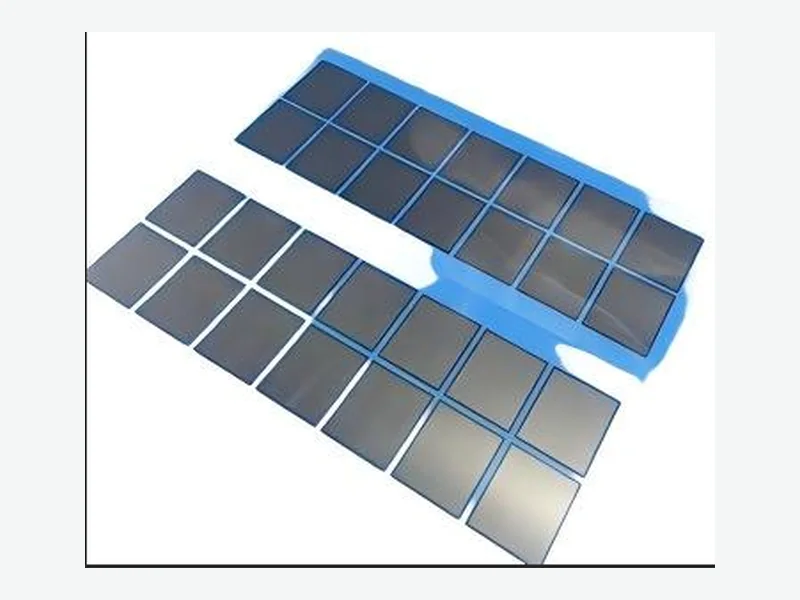
A drone ESC thermal pad works only if the installed bond-line thickness and compression pressure are controlled. Start by defining the mechanical gap and available mounting force, then compare pad thermal resistance at that operating point.
Why Compression and Gap Control Come Before Conductivity
The thermal resistance of a pad joint is the sum of the bulk resistance (thickness divided by conductivity and area) and the contact resistances at the two interfaces. In thin, well-filled joints, the contact terms can dominate, so a higher bulk conductivity number does not automatically produce a cooler ESC.[1]
For a drone ESC, the pad must fill the gap between the MOSFET or driver package and the heat spreader or housing. If the pad is too thick for the available compression, the bond line stays open and contact resistance rises. If it is too thin, the pad may not wet both surfaces, leaving air pockets.
- Measure the nominal gap and tolerance stack from the PCB, component height, and housing.
- Determine the maximum clamping force the PCB and solder joints can tolerate.
- Select a pad thickness that achieves 10–30% compression under that force.
Reading Force-Deflection Curves for Pad Selection
Thermal pad suppliers provide force-deflection curves that show compressive stress versus strain for a given grade and thickness. These curves let you estimate the pressure needed to reach a target compression, and therefore the resulting bond-line thickness.[2]
For a drone ESC, typical mounting pressures are low because the PCB is thin and the fasteners are small. A pad that requires high pressure to compress will not reach its intended thickness, leaving a thicker bond line and higher thermal resistance.
- Request force-deflection data at the exact pad thickness and operating temperature.
- Check compression set: the pad should recover enough to maintain contact after thermal cycling.
- Compare deflection force at 10%, 20%, and 30% compression for candidate pads.
Bond-Line Thickness and Tolerance Stack
Bond-line thickness is the installed pad thickness after compression. It is set by the initial pad thickness, the gap, and the applied pressure. The tolerance stack includes PCB thickness variation, component height tolerance, housing flatness, and fastener preload.
A practical approach is to define the minimum and maximum gap, then choose a pad whose compressed thickness stays within that range under the available clamping force. For example, a 1.0 mm pad compressed 20% yields a 0.8 mm bond line, but if the gap varies from 0.7 to 0.9 mm, the compression will vary from 10% to 30%.
- Calculate worst-case gap from all tolerances.
- Select pad thickness so compression stays within the supplier's recommended range.
- Verify that the compressed pad does not exceed the maximum allowable PCB deflection.
Thermal Resistance vs. Pressure: What to Specify
Thermal resistance of a pad is not a single number; it depends on pressure, thickness, and surface finish. ASTM D5470 testing measures total joint resistance at a known pressure and thickness, and a thickness series can separate bulk and contact contributions.[1]
When comparing pads, request thermal resistance versus pressure curves at the intended bond-line thickness. A pad with 6 W/m·K conductivity may perform worse than a 3 W/m·K pad if it cannot compress enough at the available pressure.
- Specify thermal resistance at the expected mounting pressure, not just bulk conductivity.
- Ask for data at the same surface finish and temperature as your application.
- Include contact resistance in your thermal budget, not just bulk resistance.
Validation Protocol for Drone ESC Thermal Pads
Before releasing a pad, validate it in a representative assembly. Measure the actual bond-line thickness after assembly using cross-sectioning or non-contact profilometry, and compare it to the design target.
Run thermal testing with the ESC under load, measuring MOSFET case temperature and board temperature. Confirm that the pad maintains contact after vibration and thermal cycling, and that compression set does not open the interface.
- Measure installed bond-line thickness on at least three assemblies.
- Perform thermal imaging or thermocouple measurements at full load.
- Subject assemblies to vibration and thermal cycling per drone operating profile.
- Re-measure bond-line thickness after environmental testing to check compression set.
Drawing and RFQ Inputs for a FLEXCEND Review
To get a useful pad recommendation, provide the nominal gap and tolerance stack, the available clamping force or fastener torque, the heat source power and target temperature, and any electrical isolation requirement.[3]
FLEXCEND can review the complete interface and recommend a pad grade, thickness, and die-cut geometry. We can also provide force-deflection and thermal resistance data for candidate materials.[3]
- Nominal gap and tolerance stack
- Available mounting pressure or fastener torque
- Heat source power and maximum allowed temperature
- Electrical isolation requirement (if any)
- Surface finish and flatness of mating parts
- 2D drawing, prototype quantity, and annual volume
Common Mistakes in Drone ESC Thermal Pad Specification
One common mistake is selecting a pad solely by thermal conductivity. A high-conductivity pad that is too stiff may not compress under the low mounting pressure of a drone ESC, leaving a thick bond line and poor contact.
Another mistake is ignoring compression set. After repeated thermal cycles, a pad that takes a permanent set will lose contact pressure, increasing thermal resistance over time.
- Do not specify pad thickness without knowing the gap tolerance.
- Do not assume higher conductivity always means lower interface resistance.
- Do not overlook compression set and long-term recovery.
What to send for a useful review
- Nominal gap and tolerance stack from PCB, component, and housing
- Available clamping force or fastener torque
- Heat source power and maximum allowed temperature
- Electrical isolation requirement (if any)
- Surface finish and flatness of mating parts
- Operating and peak temperature range
- Vibration and thermal cycling profile
- 2D drawing, prototype quantity, and annual volume
Questions teams ask during selection
What compression percentage should I target for a drone ESC thermal pad?
Most silicone thermal pads perform well between 10% and 30% compression. Below 10%, contact may be incomplete; above 30%, the pad may exert excessive force on the PCB or take a permanent set. Check the supplier's force-deflection curve for the specific grade and thickness.
How do I measure the actual bond-line thickness after assembly?
You can cross-section the assembly and measure under a microscope, or use non-contact profilometry if the pad is accessible. For production, a simple method is to measure the total stack height before and after assembly and subtract the known component and board thicknesses.
Can I reuse a thermal pad after disassembly?
Reuse is generally not recommended because the pad may have taken a compression set and lost its ability to conform. If you must reuse, inspect for permanent deformation and measure the new bond-line thickness.[4]
What is the difference between thermal conductivity and thermal resistance?
Thermal conductivity is a material property (W/m·K). Thermal resistance (K·cm²/W or °C·in²/W) includes the bond-line thickness and contact resistances. For a given pad, thermal resistance decreases with pressure and thinner bond lines, even if conductivity is constant.[1]
How do I account for PCB deflection when specifying pad compression?
Calculate the maximum allowable PCB deflection from the board thickness, component layout, and solder joint reliability limits. Then choose a pad whose compressive force at the target compression does not exceed that deflection limit. Include the pad's force-deflection curve in your mechanical analysis.
Sources and technical references
References support the published context and cited data. Final material and assembly decisions still require grade-specific documentation and application validation.
- Thermal Interface Material Testing & ASTM D5470 | ACS Materialacsmaterial.com · Accessed
- Everything You Need to Know About What is Thermal Pad Explained Simply - Sheen Technologysheenthermal.com · Accessed
- Thermal Silicone Pads engineering data and screening boundariesFLEXCEND Engineering · Accessed
- Can Thermal Pad Be Reused? Get the Facts Before You ...sheenthermal.com · Accessed