
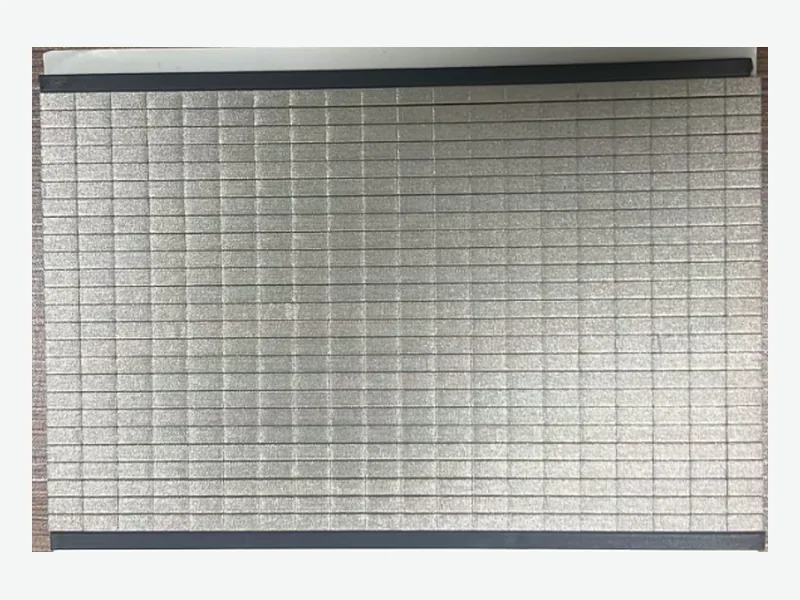
EMI gasket selection starts with the enclosure and current path. Material shielding data is useful, but it does not describe what happens across a real seam with coating, fastener spacing, compression variation and assembly wear.
Map the conductive path
Show where the gasket touches the lid, frame, PCB ground or conductive coating. Identify paint, anodizing, texture and other surface treatments that can interrupt electrical contact.
A section view is often more useful than a flat outline because it shows the seam, land width, compression direction and nearby mechanical features.
- Grounding points and conductive surfaces
- Seam length and available land
- Fastener spacing
- Coating and surface finish
Separate material data from enclosure performance
Review shielding effectiveness and resistance using the test method, frequency range, sample construction and condition supplied for the exact material. Those values support comparison; they are not an enclosure-level guarantee.
The finished assembly still requires validation because leakage can occur through seams, openings, cable entries and inconsistent contact away from the gasket itself.
Control the compression window
Define minimum and maximum installed compression from the real tolerance stack. Too little compression can break contact, while excessive force may deform the gasket, enclosure or mounting features.
For repeated service access, include the expected opening cycle, recovery requirement and surface wear in the review. For permanent assembly, adhesive, liner and installation method become part of the process definition.
- Nominal and worst-case gap
- Available closure force
- Compression and recovery evidence
- One-time or repeated opening
Release an assembly-ready construction
The finished specification should connect material grade, thickness, adhesive, liner, joint geometry and orientation to the approved drawing. Prototype parts can be used to evaluate fit, handling, contact continuity and enclosure-level EMC performance.
What to send for a useful review
- Enclosure and seam drawing
- Frequency or EMC concern
- Ground path and surface finish
- Gap and compression range
- Service-cycle requirement
- Prototype and production quantity