
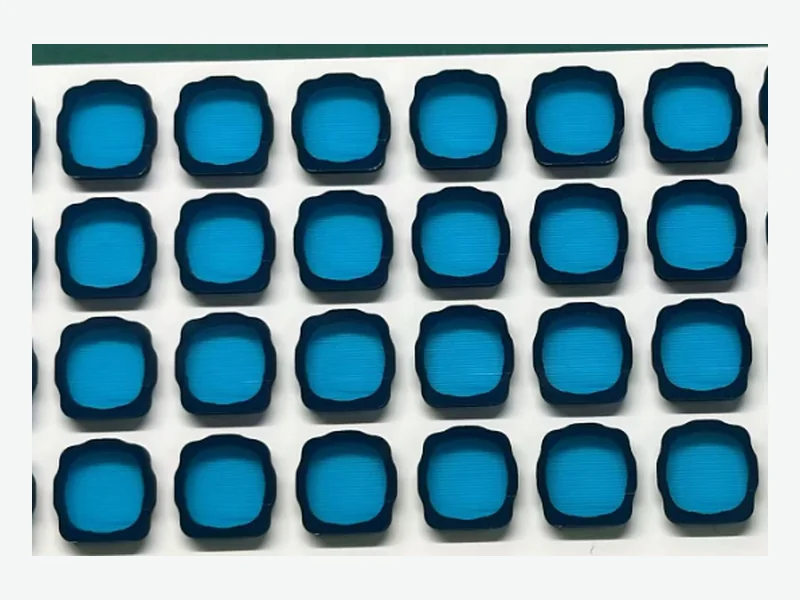
Specifying a vent membrane for an outdoor robot enclosure starts with three coupled parameters: required airflow, water-entry pressure, and adhesive land. Define these from the enclosure's free volume, expected temperature swings, and housing surface before comparing membrane materials.
Why outdoor robot enclosures need a defined breathing path
A sealed outdoor robot enclosure is never truly sealed. Temperature changes from solar load, electronics dissipation, or altitude shifts cause internal air pressure to differ from ambient. Without a controlled vent, that differential acts on gaskets, cable glands, and thin housing walls, eventually pulling moisture or dust through the weakest seal. A vent membrane provides a chosen path for air exchange while blocking liquid water and particulates.[1]
The vent must be specified as part of the enclosure system, not as an isolated component. Its location, free area, and bond line all affect how well it equalizes pressure. A membrane mounted where air cannot reach it, or with too small an area for the enclosure volume, will not prevent condensation or seal stress.[1]
- Pressure differentials from temperature swings can stress seals and thin walls
- A vent gives the enclosure a controlled breathing path
- Vent location and free area must match enclosure volume
Airflow: sizing the vent for pressure equalization
Airflow requirement is derived from the enclosure's free air volume and the fastest expected temperature or altitude ramp. A common first-order estimate uses the ideal gas law: airflow (L/hr) ≈ volume × (ΔT / 273). For example, a 10-liter enclosure seeing a 27°C change over one hour needs about 1 L/hr of airflow to keep pressure below a typical 0.5 kPa limit.[2]
Membrane airflow is always quoted at a specific pressure drop, usually 70 mbar (7 kPa). Representative adhesive vent grades from FLEXCEND show 100–270 mL/min at Δp = 70 mbar, but this is a material screening range, not a finished-part value. The actual airflow depends on vent area, membrane grade, support layers, and any cap or mesh covering.[3]
Too little airflow leaves the enclosure acting like a weak pressure vessel; too much airflow, bought by opening the pore structure, usually reduces water-entry pressure. The design target is the minimum airflow that keeps peak pressure below the gasket and cover limit under worst-case conditions.[4]
- Calculate airflow from enclosure volume and temperature ramp
- Specify airflow at a defined pressure drop (e.g., 70 mbar)
- Balance airflow against water-entry pressure
Water-entry pressure: the liquid barrier that must not be traded away
Water-entry pressure (WEP) is the minimum pressure difference that forces liquid water through the membrane. It is set by the largest pores and the membrane's surface energy. Hydrophobic ePTFE membranes rely on capillary pressure: water beads on the surface and cannot enter sub-micron pores under normal splash or spray conditions.[4]
A selected FLEXCEND membrane reference shows >0.6 bar WEP for 60 seconds, but this is material-grade data, not an enclosure guarantee. The installed vent's WEP depends on the adhesive bond, housing compression, and any damage during assembly. IP65–IP68 targets can only be claimed after validating the complete vent, bond, housing, and installation assembly.[3]
WEP is liquid-specific. Oil, coolant, detergent, or alcohol has lower surface tension than water and can wet a membrane that passes a water test. If the robot may encounter such fluids, an oleophobic grade should be specified and tested with the actual fluid.[4]
- WEP is set by largest pores and surface energy
- Material WEP is not the same as installed IP rating
- Test with actual fluids if oils or surfactants are present
Adhesive land: the bond that makes or breaks the vent
The adhesive frame is often the weakest link in a vent membrane assembly. It must bond to the housing surface, which may be low-surface-energy plastic, textured, or contaminated. The bond width, adhesive chemistry, and surface preparation all affect long-term sealing and WEP retention.[3]
FLEXCEND can convert custom adhesive frames with defined aperture, bond width, outer profile, liner, and assembly tab matched to the housing surface. The adhesive stack must be selected for the substrate, temperature range, and environmental exposure. A drawing that specifies only the membrane material without the adhesive land is incomplete.[3]
Low-surface-energy plastics like polypropylene or powder-coated metals may require surface treatment or a specialized adhesive. The bond must also withstand thermal cycling, UV, and moisture without losing adhesion or allowing a leak path.[5]
- Adhesive bond width and chemistry must match housing surface
- Specify liner, tab, and outer profile for assembly
- Validate bond after thermal cycling and environmental aging
Decision matrix: selecting a vent membrane for your enclosure
Use the following matrix to compare candidate membranes. Score each parameter from 1 (poor) to 5 (excellent) based on datasheet values and your application requirements. A membrane that scores high on airflow but low on WEP may be unsuitable for a washdown environment.
- Airflow at 70 mbar: does it meet calculated requirement?
- Water-entry pressure: is it above worst-case pressure differential?
- Adhesive compatibility: does it bond to your housing material?
- Temperature range: does it cover storage and operating extremes?
- Chemical resistance: will it survive oils, cleaners, or UV?
- Assembly fit: does the die-cut shape match your vent opening?
Validation protocol: proving the vent works in your robot
A bench test of the membrane alone is not enough. The following sequence validates the vent as installed in the enclosure. Start with a visual and dimensional check of the die-cut part, then proceed to functional tests.
First, measure airflow through the installed vent at the specified pressure drop. Then run a water-entry pressure test on the vented enclosure, not just the membrane. Finally, subject the assembly to thermal cycling and environmental aging, then repeat the airflow and WEP tests to check for degradation.[2]
- Dimensional check of die-cut vent and adhesive land
- Airflow test at 70 mbar on installed vent
- Water-entry pressure test on complete enclosure
- Thermal cycling (-20°C to +60°C, 10 cycles) followed by retest
- Optional: dust exposure test per ISO 20653 or equivalent
Drawing inputs that make a FLEXCEND review useful
To get an accurate quote and a manufacturable part, provide the following on your drawing or RFQ. Missing information leads to assumptions that may not match your application.[3]
- Enclosure free volume and vent opening size
- Required airflow at a defined pressure drop
- Target water-entry pressure or IP rating
- Housing material and surface finish
- Adhesive bond width and any surface treatment
- Temperature, altitude, and fluid exposure
- Expected annual volume and any special packaging needs
What to send for a useful review
- Enclosure free volume (liters) and vent opening dimensions
- Required airflow (mL/min) at 70 mbar or other defined Δp
- Target water-entry pressure (bar) or IP rating
- Housing material, surface energy, and texture
- Adhesive bond width and any surface preparation
- Temperature range, altitude, and fluid exposure
- Expected annual volume and packaging requirements
- Any acoustic or particle filtration requirements
Questions teams ask during selection
What airflow do I need for my enclosure?
Estimate airflow from enclosure volume and fastest temperature ramp using the ideal gas law. For a 10 L enclosure with a 27°C change over one hour, about 1 L/hr is needed. Then select a membrane area that provides this airflow at your allowable pressure drop.[2]
Is a higher water-entry pressure always better?
Not necessarily. Higher WEP often comes from smaller pores, which reduces airflow. Specify the minimum WEP that covers your worst-case pressure differential and fluid exposure, then maximize airflow within that constraint.[4]
Can I use the same vent for a microphone opening?
Possibly, but acoustic performance must be considered. The membrane's insertion loss or transmission data should be reviewed for the specific microphone and aperture. FLEXCEND can supply acoustic data for selected media.[3]
How do I bond a vent to a low-surface-energy plastic?
Low-surface-energy plastics may require surface treatment (plasma, corona, or primer) or a specialized adhesive. The adhesive stack must be selected for the substrate and validated with thermal cycling and environmental aging.[5]
What IP rating can a vent membrane achieve?
IP65–IP68 may be targeted only through a validated vent, bond, housing, and installation assembly. The membrane's material WEP is a screening value, not a guarantee of the installed system's rating.[3]
Sources and technical references
References support the published context and cited data. Final material and assembly decisions still require grade-specific documentation and application validation.
- Reticulated Foam Filters & ePTFE Vents | H-O Productsh-oproducts.com · Accessed
- How to Design Effective Enclosure Vents: Balancing Pressure, Moisture, and Protectionrogerscorp.com · Accessed
- Dust Mesh & Vent Membranes engineering data and screening boundariesFLEXCEND Engineering · Accessed
- ePTFE Pore Size, WEP and Airflow in Protective Ventsspider-amoy.com · Published · Accessed
- PTFE Oleophobic Venting Membranes Improve System ...linkedin.com · Accessed